Twelve Possessions, One Number: Untangling the Army-Navy Totals Market in 2026
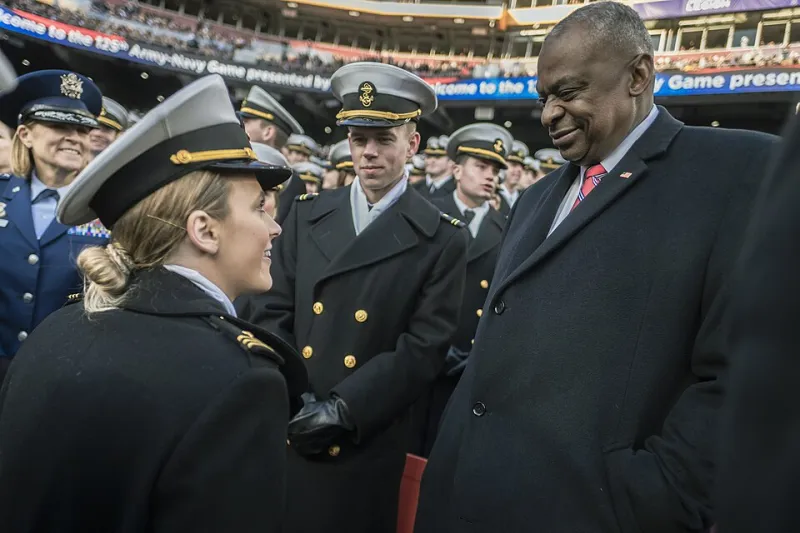
Photo: U.S. Secretary of Defense, CC BY 2.0, via Wikimedia Commons
Army-Navy is one of the best spectacles on the American sports calendar. It is also one of the most forecastable games in college football, at least on the surface. Two run-first service academies, a December date, a compressed play count, and a national audience that has been trained to expect a rock fight. The total should be low. It usually is. But low is not the same as mispriced, and the 2026 game is a good reminder that the most obvious betting angle is often the one the market has already taxed.
The obvious under is not a free square
The public sees Army and Navy and immediately thinks under. Option football, long drives, limited possessions, bad weather, coaches who would rather punt than risk a turnover. That story is mostly true. It is also on every betting preview, every broadcast segment, and every group chat from Annapolis to West Point. When a narrative is that loud, sportsbooks do not ignore it. They shade the number down and charge you for the privilege of agreeing with the crowd.
That is the first trap. An Army-Navy total in the low 30s is not a conservative bet by default. It asks both teams to avoid short-field touchdowns, defensive scores, special-teams mistakes, and late-game desperation. If you need 10-play drives to end in punts over and over, you are not betting a safe game. You are betting a clean one. Clean is not guaranteed.
Possession math beats vibes
Army-Navy games tend to produce fewer possessions than a typical college game. That is the real reason totals are low, not some mystical service academy magic. Call it 10 to 12 possessions per side in a normal game script. If the total is 34, each team needs roughly 17 points. Across 11 possessions, that is about 1.5 points per possession. A single touchdown is a massive swing. A pick-six or a blocked punt can flip the entire number in one breath.
Limited possessions amplify variance. They do not suppress it. Under bettors often talk about the clock as if it guarantees empty drives. Over bettors talk about efficiency as if every red-zone trip ends in seven. The truth is that a short game makes every turnover, every fourth-down decision, and every field-goal attempt more important. One busted assignment on the perimeter can turn a 13-10 grinder into a 20-17 cover problem.
Where the market tends to overcorrect
Historically, Army-Navy unders have been a popular public play, and in some past seasons that was justified. The totals were low, the styles were extreme, and the clock kept moving. But markets learn. Sportsbooks have spent years adjusting to the public's under bias. In recent seasons, the number has often been shaded to a point where the under needs a very specific game script to cash.
That does not mean the over is automatically the play. It means the number matters more than the acronym. If a clear-weather game with experienced quarterbacks and healthy fullbacks gets bet down to 30 or below, the over becomes live. Two touchdowns and three field goals gets you to 23. Add a defensive score or a late drive and the over is home. On the other hand, if the total gets pushed up into the high 30s because the public expects a shootout for some reason, the under can be the value. The trap is not picking a side. The trap is picking a story.
Weather is a factor, not a headline
December weather in Philadelphia, Baltimore, or wherever the game lands is part of the puzzle. Wind matters more than cold for kicking and passing. Rain matters because it creates fumbles and slippery footing, which can shorten fields and create cheap points. Snow can turn a clean game into chaos. Army and Navy are better equipped for bad weather than most teams because they run the ball, but that does not mean weather automatically helps the under. A wet ball can produce a strip-sack and a 10-yard touchdown drive just as easily as it can produce a punt.
The sharper approach is to separate weather that suppresses scoring from weather that creates short fields. A 20-mph wind and a shaky kicker is an under-friendly combination. A steady rain with two teams that protect the ball is not automatically an under. Check the forecast the morning of the game, not three weeks out.
Motivation and game script
The Commander-in-Chief's Trophy can make this game weird. If the trophy is already decided, one team may play with less urgency. If it is on the line, both staffs may coach conservatively early and aggressively late. Senior day emotion matters, but it is hard to quantify. What matters more is how the game script develops. A team protecting a 10-point lead in the fourth quarter is an under bettor's best friend. A team down 10 with six minutes left is an over bettor's best friend, because the clock stops on incompletions and the playbook opens up.
A practical checklist for the 2026 total
- Shop the number. Openers can be shaded, and a half-point at 31 or 34 matters. Compare prices before you bet.
- Know the key totals. Numbers around 27, 30, 31, 34, and 37 are not interchangeable.
- Check quarterback and fullback health. These offenses depend on timing and physical runners.
- Look at special teams. A reliable kicker raises the floor. A shaky punter creates short fields.
- Wait for weather. Wind and precipitation reports on game day are more useful than forecasts from midweek.
- Think live. Early turnovers can overreact the live total in either direction.
- Avoid forcing the total into a same-game parlay. Army-Navy is volatile enough on its own.
Bottom line
Army-Navy is predictable in style and unpredictable in scoring. That is the paradox the market lives in. The 2026 total will likely be low, the public will likely lean under, and the books will likely price that lean into the number. Your job is not to out-narrative the crowd. Your job is to decide whether the number itself is too low, too high, or fairly priced. At K89Bet, the goal is sharp odds and smarter bets, not sentimental ones. Respect the under. Just do not pay full price for it.